Hysteresis and adaptation time scales of salt intrusion and the Turbidity Maximum Zone in a tidal estuary/
Hysteresis and adaptation time scales of salt intrusion and the Turbidity Maximum Zone in a tidal estuary
Consuegra, C., Becker, M., Kösters, F., & Winter, C. (2025). Hysteresis and adaptation time scales of salt intrusion and the Turbidity Maximum Zone in a tidal estuary. Journal of Hydrology, 661, 133564. https://doi.org/10.1016/j.jhydrol.2025.133564
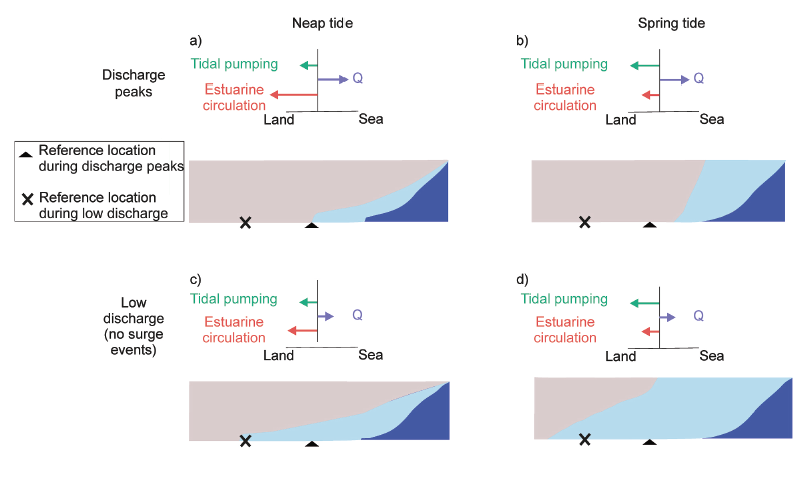
This study investigates the response of salt intrusion and Turbidity Maximum Zone (TMZ) to changes in the river discharge, tides and coastal conditions. The study is carried out in the Weser Estuary, a typical funnel-shaped tidal estuary in the North Sea. The results show that the estuary does not respond immediately to changes in external forcing. Significant spatial and temporal lags are found in response to changes in drivers. There is a hysteresis between discharge and salt intrusion and TMZ location. The estuary follows different pathways while adjusting to increasing and decreasing flows. Changes in river discharge produce the largest shifts, whereas changes in tidal range have a smaller and more rapid effect. Storm surges can cause substantial, but short-term variations. Overall, the findings highlight that estuaries are in a continuous state of adjustment.